
Cleaning Schedule for Single Working Moms That Actually Works
Some evenings I walk through the door at 6 p.m. both kids talking at once bags everywhere dinner still unmade and I look around at the state of the house and think: how does anyone keep on top of this?
Get the complete cleaning-schedule
Daily, weekly & monthly tasks ready to print or save as PDF.
The answer it turns out is not cleaning more. It is cleaning smarter. And for single working moms especially that means having a system that works around your actual life rather than the life you imagine having on a calm unhurried Sunday morning.
Why Most Cleaning Schedules Fail for Single Working Moms
Before we get into the schedule itself it helps to understand why the standard advice tends to fall flat.
Most cleaning guides are written with two adults and a free weekend in mind. They assume someone has the energy for a full Saturday blitz or a partner to cover the kids while the other cleans. That assumption breaks down completely when you are the only adult in the house and every task lands on your list.
The other reason schedules fail is they try to do too much at once. A clean home is not the result of one massive effort. It is the result of a little bit done consistently. When you clean in short daily bursts rather than saving everything for the weekend, the house stays at a manageable baseline all week. You are not playing catch-up constantly. You are just maintaining.
Before You Start: Set Up for Success
Step 1: Assess your home honestly
Every home and every family is different. Before adopting any schedule, look at which areas of your home get the most traffic and which ones tend to fall apart fastest. For most families with kids, that is the kitchen, the main bathroom and whatever room the kids spend most time in. Those are the areas that need daily attention. The guest bedroom can wait.
Step 2: Declutter first
A cleaning schedule cannot work in a home full of clutter. Before you start any routine, do one pass through each room and remove anything that does not need to be there. You do not have to do this all at once. One room or one corner at a time is fine. But reducing clutter makes every subsequent cleaning session faster and less overwhelming.
Step 3: Get your supplies organized
Keep a small cleaning caddy stocked and ready in each main area of the house, or keep one central caddy you carry room to room. Not having to search for supplies is a surprisingly significant time saver.
Step 4: Decide when you will clean
The biggest predictor of whether a cleaning routine sticks is whether it is scheduled at a specific time rather than left to whenever you feel like it. If you are a morning person ten minutes before the kids wake up works well. If evenings are better right after the kids go to bed is a good slot. The exact time matters less than it being consistent.
The Daily Cleaning Routine: 20 to 30 Minutes Total
These are the non-negotiables. The tasks that if done every single day, keep your home from descending into chaos regardless of what else happens during the week.
Morning Tasks (10 to 15 minutes)
Evening Tasks (10 to 15 minutes)
The Weekly Cleaning Schedule: One Task Per Day
Assign one bigger cleaning task to each day of the week. Each task should take 15 to 30 minutes at most once you are in the habit. You are not deep cleaning. You are maintaining.
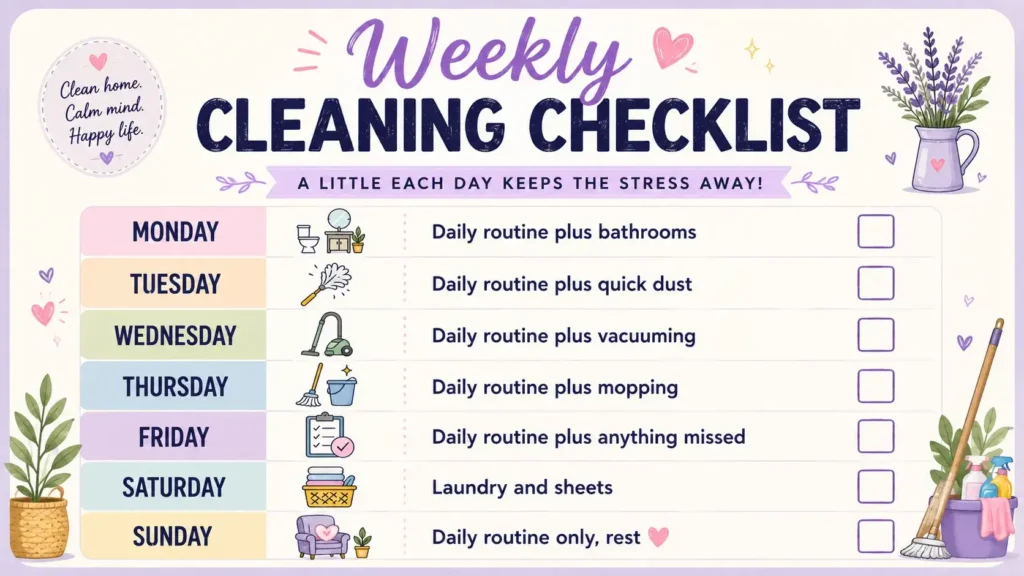
Why this works: You are never doing more than one significant task per day. If Monday’s bathroom clean does not happen because the kids were sick or work ran late you skip it and move on. Friday’s catch-all day gives you a built-in buffer. You just keep going.
What Each Task Actually Involves
Monday: Bathrooms Scrub the toilet, sink and tub or shower. Disinfect high-touch points like light switches, door handles, and taps. Empty the bin. Replace towels if needed and restock any supplies that are running low.
Tuesday: Dusting Wipe down shelves, surfaces, skirting boards and fan blades. A microfibre cloth makes this fast. Work from top to bottom so dust falls to the floor and gets picked up in the next session.
Wednesday: Vacuuming Vacuum all rugs, carpets and fabric furniture. For homes with children, this is the task that makes the biggest visible difference. Crumbs and debris on floors are one of the fastest ways a home starts to look and feel chaotic.
Thursday: Washing floors Mop or damp-mop all hard floors. This is the task most people skip first when time gets tight. It also makes a surprising difference to how clean the home smells and feels.
Friday: Catch-all day Look at what did not get done this week. Do those tasks now, or carry them to the following week if you genuinely do not have time. Use Friday to also address any specific thing that has been bothering you, a messy drawer an overflowing cupboard, something you have been walking past all week.
Saturday: Sheets and towels Strip beds and wash bedding. Wash bath towels. This one runs mostly in the background while you do other things so the active time is just loading, moving, and folding.
Sunday: Light and rest Sunday is not for cleaning. Do the daily routine and nothing more. You need a day where the house does not make demands on you.
Monthly Cleaning: Deep Tasks
These tasks only need to happen once a month. Spread across four weeks, they barely register as extra work because you are only adding one to your week at a time.
Week 1
Clean skirting boards, door frames and light switches throughout the house
Week 2
Wash windows, mirrors and any glass surfaces.
Week 3
Deep clean the refrigerator and oven
Week 4
Vacuum and clean behind large furniture under sofas and beds
15-Minute Laundry System
Laundry is one of the things that can quietly derail an otherwise functional home. Here is the simplest version of a system that keeps it manageable:
Every day, spend roughly 15 minutes on laundry. Gather clothes from around the house, put a load in. Fold the load from yesterday. Put it away. That is it. With a family of two or three, one load per day keeps the pile from ever becoming unmanageable. You will always have clean clothes. You will never face a mountain of laundry on a Saturday.
How to Get Your Kids Involved
This section matters more than any specific cleaning task I can give you.
Involving your children in household cleaning is not about putting extra work on them. It is about raising capable people who understand that home is a shared responsibility.
A long-term University of Minnesota study found that children who started doing chores as young as three or four were more likely to succeed academically, build strong relationships, and become self-sufficient adults. The American Academy of Pediatrics agrees that age-appropriate chores build genuine confidence and a sense of contribution in children.
2–4 years
5–7 years
8–11 years
12 & up
If you need more help with daily structure and routines that work when you are parenting solo our post on how to discipline kids without a co-parent has some useful ideas for building systems your kids actually follow.
Tips to Make the Whole Thing Easier
Use the 1-minute rule.
Anything that takes under a minute to deal with, deal with immediately. Put the item away, file the paper, wipe the surface. This single habit prevents the accumulation of small messes that make a home feel chaotic even when nothing is technically dirty.
Use timer-based cleaning.
Set a timer for 15 or 20 minutes. Clean until it goes off. Stop when it stops. Knowing there is a defined end to the session makes it far easier to start especially on evenings when you are exhausted and the last thing you want is an open-ended cleaning task.
Keep supplies visible and accessible.
A spray bottle and cloth under the bathroom sink means you can wipe the basin in 60 seconds when you notice it needs it. Supplies that are stored away in a cupboard get used far less.
Focus on high-traffic areas first.
If you only have 10 minutes the kitchen and main bathroom will make the biggest difference to how the house looks and feels. Perfect is not the goal. Livable is.
Let some things go.
The guest room does not need to be spotless every week. The playroom is going to be messy again in an hour. A surface that is clean enough is clean enough. Perfectionism about housekeeping is one of the fastest routes to burnout for single moms and you do not have the luxury of burning out.
When to Consider Professional Help
There is no shame in getting help with cleaning when your schedule or energy genuinely does not allow for it. Professional cleaning services come in many forms from a full-service clean once a month to a one-off deep clean when life gets particularly overwhelming.
If cost is a barrier it is worth knowing that many cleaners offer flexible options: a monthly deep clean of just the kitchen and bathrooms for example while you maintain the rest. Even one professional session per month can reset the baseline and make your weekly maintenance significantly easier.
If you are in a season where money is especially tight and every decision has to count our guide on how to build a budget on one income might help you find room in the budget for something that genuinely takes pressure off.
Frequently Asked Questions
What is the most important cleaning task to do every day?
The kitchen reset. Wipe down counters, clear the table, load and run the dishwasher. A clean kitchen makes the whole house feel more under control. If you only do one thing in the evening, do this.
What do I do when I fall behind on cleaning?
tart where you are. Do today’s daily routine. Do not try to catch up on everything that did not happen this week. Friday’s catch-all day is your safety net. If even Friday does not work out, the weekly tasks simply carry forward to next week. Consistency over time matters more than perfection in any given week.