
Free Budget Planner Printable for Single Moms
I know how it feels going from two incomes down to one. How exhausting it can be to worry about your kids when you can barely catch your breath yourself. How “at capacity” everything feels in those first few months of doing this alone.
That’s exactly why I built this printable. Not adapted from a two-income household template with the second column crossed out but built from scratch around what a single-income budget actually needs to cover.
Download Budget Planner Printable
Why Single Moms Need a Different Kind of Budget
Most budget templates online are built for two-parent, two-income households then handed to single moms as-is. The math doesn’t hold up the same way. There’s no second paycheck to fall back on when childcare costs spike, no partner’s income to average against yours, and often a support payment that may or may not show up on time.
A budget built for your actual situation looks different. It plans around one income from the start, builds in a buffer for support payments that are inconsistent and treats childcare as the major line item it actually is rather than an afterthought.
What’s Included in the Free Printable
Download the free printable here and print as many copies as you need. It works whether you’re starting your very first budget or resetting one that’s stopped working for you.
Choose the Budgeting Method That Fits Your Life
There’s no single correct way to budget. The best system is the one you’ll actually stick with and that looks different from one household to the next. Here are the three most common approaches, and how each one plays out for a single-income household.
Zero-Based Budget
Every dollar of your income gets assigned a job before the month starts, whether that’s a bill, savings, or spending money, until your income minus your expenses equals zero. This method gives you the most control and the clearest picture of where every dollar is going which makes it a strong fit if you’re rebuilding a budget from scratch after a big income change.
50/30/20 Budget
A simpler split: 50% of your income toward needs, 30% toward wants and 20% toward savings and debt. This method takes less daily upkeep than a zero-based budget, which makes it a good starting point if you’re new to budgeting or don’t have much extra time to manage detailed categories right now.
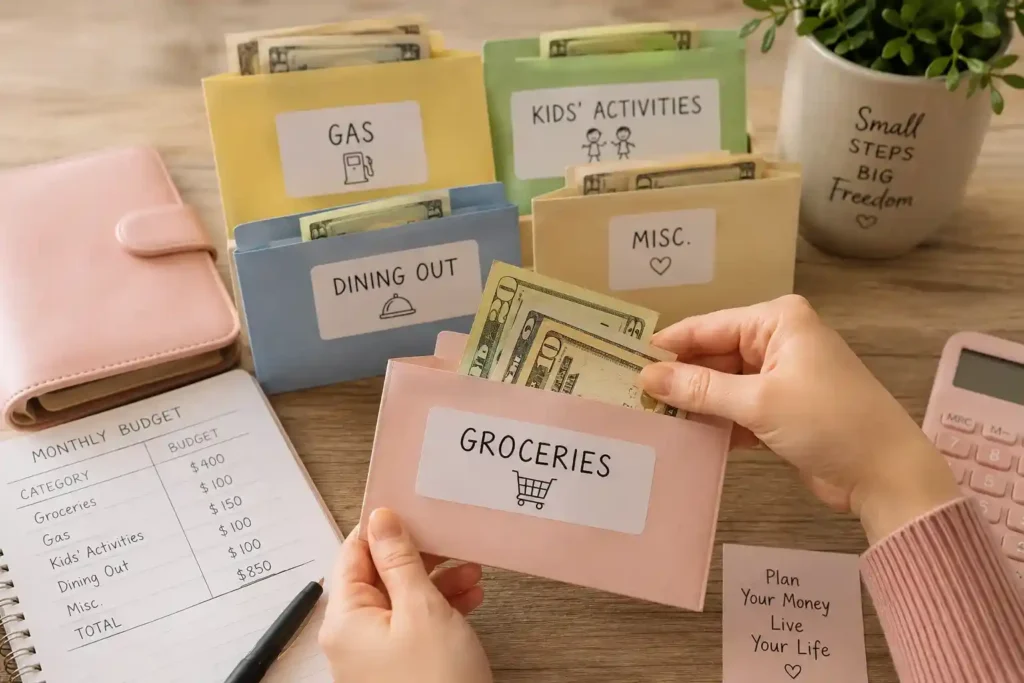
Cash Envelope System
You withdraw cash for specific spending categories, groceries, gas, kids’ activities and put it into labeled envelopes. Once an envelope is empty spending in that category stops for the month. This is a strong option if overspending on cards is your biggest challenge since it makes your spending limit physical and visible.
Try one system for a full month before deciding it’s not for you. Most budgets feel clunky for the first few weeks no matter which method you pick.
What to Include That Most Templates Miss
A budget built for two incomes tends to leave out a few things that matter enormously on one.
Childcare as its own major category, not a footnote. For many single moms, childcare is the second or third largest expense after housing not a small line item folded into “miscellaneous.”
A buffer for inconsistent child support. If support payments are part of your income and don’t always arrive on schedule, build your baseline budget around your income without them and treat any support that does come in as a bonus toward savings or debt.
A right-sized emergency fund. On one income, a job disruption hits harder and faster. Start with a small buffer of $500 to $1,000 before anything else then build toward three months of expenses over time.
Sinking funds for the irregular stuff. School supplies, birthday parties, car repairs. Setting aside a small amount monthly for these prevents them from becoming a surprise that wrecks an otherwise fine month.
If you want a deeper walkthrough of building all of this out this guide to building a budget on one income goes step by step through the full process.
Tips for Sticking to Your Budget
Getting a good template is only half the equation. Here’s what actually keeps a budget working past the first month.
Track your progress weekly, not just monthly. A few minutes each week reviewing your spending catches small problems before they become big ones. Waiting until the end of the month to look at your numbers usually means finding out too late.
Don’t let one missed day turn into a missed week. Budgets fall apart in small moments, not big ones. If you overspend one day, the goal is getting back on track the next day, not writing off the rest of the month.
Look for ways to boost income, not just cut spending. A budget can only cut so much before you’re cutting into things that matter. A side hustle, even a small one, can create room a stricter budget alone can’t. These stay-at-home job ideas are a reasonable place to start if extra income is part of your plan.
Open a high-yield savings account for anything you’re setting aside. Your emergency fund and sinking funds earn meaningfully more interest sitting in a high-yield account than a standard savings account for zero extra effort.
Automate what you can. Automatic transfers to savings and automatic bill pay reduce the number of decisions you have to make each week, which matters when you’re already making every other decision in the house alone.
If cutting expenses further is part of your plan too these 50 ways to save money as a single mom pairs well with whichever budgeting method you choose.
Frequently Asked Questions
How much should a single mom budget for childcare?
Childcare costs vary widely by location and a child’s age but it’s common for childcare to be the second-largest expense after housing on a single income. Treat it as a dedicated category in your budget rather than folding it into general expenses.
How much should I have in an emergency fund as a single mom?
Start with a smaller goal of $500 to $1,000, which covers most small emergencies. From there build toward three months of expenses over time since a single income has less of a buffer if work is disrupted.